
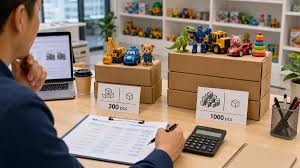
Understanding and negotiating Minimum Order Quantities (MOQs) is key for toy exporters. It involves finding suppliers willing to work with your needs and building lasting business partnerships. This guide will help you navigate these crucial discussions.
What Exactly is a Minimum Order Quantity (MOQ)?
Think of MOQ as the smallest amount a supplier will sell you. It’s a number they set. They do this for good reasons.
It helps them manage their business. It makes production cost-effective for them. For example, a factory might have to set up machines for a specific toy.
Running them for just a few items costs them a lot. Running them for hundreds or thousands makes more sense. So, they ask you to buy a certain number.
This number is their MOQ.
MOQs can vary a lot. They depend on the toy. They depend on the factory.
They depend on the materials used. Some MOQs are low. Others can be very high.
This is where the negotiation comes in. It’s not always a fixed number. It’s a starting point for discussion.
Understanding this is the first step. It helps you approach suppliers with a clearer mind.
Why are MOQs so important to factories? Well, production costs aren’t just about the plastic. There are setup costs for machinery.
There are costs for tooling and molds. There are labor costs for each run. If they only make a few toys, these setup costs are spread over very few items.
This makes each toy very expensive for the factory. They wouldn’t make much profit. Or they might even lose money.
Asking for a higher order quantity helps them cover these costs. It also helps them achieve economies of scale.
This means the cost per unit goes down. As the order gets bigger, the factory can produce more efficiently. They use their resources better.
This is good for them. It can also be good for you. When they produce more, they can often offer you a better price per toy.
So, while MOQs can seem like a barrier, they are also linked to better pricing. It’s a trade-off you need to understand.
The materials themselves can also play a role. Some toys use very common plastics. Others use special, imported, or expensive materials.
If a material is hard to get or has a high minimum purchase order for the factory, they’ll pass that cost onto you. This can also drive up the MOQ. The complexity of the toy matters too.
A simple puzzle might have a lower MOQ than a complex action figure with many parts and electronics.
So, when you see an MOQ, remember it’s not just an arbitrary number. It’s tied to the factory’s costs and their ability to make production work for them. Your goal is to find a way to align your needs with theirs.
You want to find that sweet spot where both of you can do business happily.
My Own MOQ Struggle: A Case Study in Toy Exports
I remember my first big toy export deal. I had this amazing idea for a line of wooden educational toys. They were beautifully crafted.
I felt sure they’d do well. I found a factory in Southeast Asia that made similar items. They seemed perfect.
I sent them my designs and asked for a quote. The reply came back quickly. It included the price per unit.
It also included the MOQ.
My heart sank. The MOQ was 5,000 units per design. For a new business like mine, that felt like an impossible mountain.
I only had the capital to produce maybe 500 of each. I panicked a little. I thought, “This is it.
My dream is over before it even began.” I almost gave up right then. The email sat there for a day. I reread it a dozen times.
I felt so small and powerless. It was a cold, hard business reality.
Then, I took a deep breath. I remembered what my mentor always said: “Every problem is just a puzzle waiting to be solved.” I decided to see the MOQ not as a “no,” but as a “not yet” or “not this way.” I replied to the factory. I didn’t argue or complain.
Instead, I explained my situation. I was a startup. I was testing the market.
I wanted to build a long-term relationship. I asked if there was any flexibility. I asked if they could do a smaller batch, maybe 1,000 units.
I offered to pay a little more per unit for the smaller order. I also asked about combining different designs to reach a higher total order. Could 1,000 of design A, 1,000 of design B, and 3,000 of design C count as 5,000 total?
I was looking for any loophole, any compromise.
This showed them I was serious. I wasn’t just some tire-kicker. I was trying to find a way to work with them.
The factory manager was kind. He understood my situation. He explained their own constraints.
He said setting up the machines for a new toy took time and money. But, he was willing to try. He said they could do 1,000 units per design for a slightly higher price per unit.
He also agreed to let me combine designs. My total order still needed to be around 5,000 units. But I could mix and match.
This was a huge win! I could launch three different toys with 1,000 units each. Then I could order more of the bestsellers.
It wasn’t perfect, but it was a start. It taught me that open communication and a willingness to compromise go a long way.
MOQ Negotiation: Key Takeaways from Experience
Offer to Pay More: If you need a smaller quantity, offering a higher price per unit shows you value their flexibility.
Propose Combinations: Ask if you can mix different product designs to meet a larger total order quantity.
Highlight Long-Term Potential: Emphasize your desire for a lasting partnership and future growth.
Be Transparent: Clearly explain your current business stage and constraints.
Stay Polite and Professional: Maintain a respectful tone, even when discussing difficult numbers.
Why Do Suppliers Have MOQs? Unpacking the Factory’s Perspective
Let’s dig a little deeper into why factories insist on MOQs. It’s not to make your life difficult. It’s about their business survival and efficiency.
Think about the process of making toys. It’s not like baking cookies at home. It involves big machines and specialized setups.
First, there’s the cost of tooling and molds. For many toys, especially plastic ones, you need specific molds. These are like the cookie cutters, but much bigger and more expensive.
Creating a high-quality mold can cost thousands of dollars. The factory has to make back this investment. If they only make 100 toys from a mold, it will take them a very long time to recoup that cost.
So, they need to produce a significant number of items using that mold to make it worthwhile.
Then comes the machine setup. For each new product or a large batch of an existing product, machines need to be calibrated and set up. This takes time and skilled labor.
The machines might need to be cleaned or adjusted for different colors, sizes, or specifications. This setup time is essentially “dead time” for production. The more you order, the longer the machines can run continuously.
This makes the setup cost per unit much lower.
Material purchasing is another factor. Factories often buy raw materials like plastic pellets, paint, or fabric in bulk. Their suppliers also have MOQs.
So, a toy factory might have to order 500 kilograms of a specific blue plastic. If they only need enough for 100 toys, they’ll have a lot of leftover material. This ties up their capital.
It also creates storage issues. They prefer to order materials that will be used up quickly in large production runs.
Labor efficiency is also tied to MOQ. Workers get faster and more efficient as they produce more of the same item. The first few items might be slower.
But after a while, they develop a rhythm. This increases output and reduces errors. If they’re constantly switching between different small orders, their overall efficiency drops.
This means higher labor costs per unit.
Finally, there’s the administrative overhead. Every order involves paperwork, quality checks, packaging, and shipping arrangements. For a very small order, the administrative effort might be almost as much as for a large order.
This makes small orders less profitable from an administrative standpoint.
So, when a factory states an MOQ, it’s usually the minimum number that makes the production process economically viable and efficient for them. It’s the point where they can cover their fixed costs and make a reasonable profit. Understanding these factors helps you approach negotiation with respect for their business needs.
Factory Cost Breakdown Simplified
Molds & Tooling: The initial big expense to create the product shape.
Machine Setup: Time and effort to get production lines ready.
Raw Materials: Buying plastic, paint, etc., often in large quantities.
Labor: Efficient use of factory workers.
Admin & Overhead: Paperwork, quality control, shipping.
Types of Toy Exports and Their Common MOQs
The world of toy exports is vast. Different types of toys have different production processes. This directly affects their MOQs.
Knowing these differences helps you set realistic expectations.
Plush Toys: These are soft toys made from fabric and stuffing. The materials are often flexible. Molds aren’t typically the main cost here.
However, custom patterns, embroidery, and sewing require setup. Factories often have standard plush toy types they can make quickly. For highly custom plush toys with unique shapes or features, MOQs can range from 500 to 3,000 units per design.
Simpler, standard shapes might have lower MOQs, perhaps 200-500.
Plastic Injection Molded Toys: This is where MOQs can get high. Think action figures, building blocks, or simple toy vehicles. The cost of creating precise injection molds is significant.
A single mold can cost $1,000 to $10,000 or more. Because of this high upfront cost, factories need to produce thousands of units to make it worthwhile. MOQs for these toys often start at 1,000 units per design.
But for more complex or specialized items, it can easily go up to 5,000 or 10,000 units. Sometimes, factories will have existing molds for common toy parts. If you can use those, your MOQ might be lower.
Wooden Toys: These include puzzles, building blocks, and educational toys. Production involves cutting, shaping, sanding, and painting wood. While there might be custom cutting tools, they are often less expensive than injection molds.
However, painting and finishing still require setup. MOQs for wooden toys can vary. A simple wooden car might have an MOQ of 500-1,000 units.
More intricate puzzles or toys with many painted parts might have MOQs of 1,000-3,000 units.
Educational Toys & STEM Kits: These often involve multiple components. This could be plastic parts, electronics, cardboard, and instruction manuals. The complexity of sourcing and assembling these kits affects MOQs.
If the components are standard, the MOQ might be lower. If custom parts are needed, the MOQ will be higher, driven by the most complex component’s MOQ. You might see MOQs ranging from 500 to 2,000 units.
Board Games & Puzzles: These involve printing, die-cutting cardboard, and often plastic or wooden pieces. Printing runs have their own MOQs. A large print job for game boards or puzzle pieces might have an MOQ of 500-1,000 units.
If custom game pieces are involved, that adds complexity and potentially higher MOQs. Packaging also plays a role; custom boxes have setup costs.
Electronic Toys: These are the most complex. They involve circuit boards, batteries, sound chips, and more. The electronic components themselves have MOQs from their suppliers.
The assembly process is also more involved. For simple electronic toys, MOQs might start at 500-1,000 units. For more advanced toys with custom programming or unique electronic features, MOQs can easily be 2,000 units or more.
It’s crucial to research the typical MOQs for your specific toy category. This helps you understand if a supplier’s quote is standard or unusually high. It also guides your negotiation strategy.
Toy Type vs. MOQ Expectation
Plush Toys: 200 – 3,000 units
Plastic Toys: 1,000 – 10,000+ units
Wooden Toys: 500 – 3,000 units
STEM Kits: 500 – 2,000 units
Games/Puzzles: 500 – 1,000+ units
Electronic Toys: 500 – 2,000+ units
Finding Suppliers Who Can Work With Your MOQ Needs
The first step in successful MOQ negotiation is finding the right suppliers. Not all factories are created equal. Some are geared towards massive production runs.
Others are more flexible and willing to work with smaller businesses.
Online B2B Platforms: Websites like Alibaba, Made-in-China, and Global Sources are good starting points. You can filter suppliers by product category. You can often see their listed MOQs.
However, be cautious. These listed MOQs are sometimes just a guideline. Many suppliers will still negotiate.
Look for suppliers who mention “small orders welcome” or “customization available.” Pay attention to their response rate and customer reviews.
Trade Shows: Attending toy industry trade shows is invaluable. You can meet suppliers face-to-face. You can see their products.
You can have direct conversations about your needs. Many smaller and medium-sized factories exhibit at these shows. They are often more willing to work with newer businesses than giant corporations.
You can build a personal connection, which is powerful in negotiations.
Industry Directories and Associations: Look for directories specific to the toy industry or the region you’re interested in manufacturing in. Industry associations often have member lists of manufacturers. These can be curated lists of more reputable or accessible companies.
Referrals and Networks: Ask people in the toy industry for recommendations. If you know other exporters or retailers, they might have suppliers they trust. A personal referral often means a supplier is already known for being reliable and potentially flexible.
Agents and Sourcing Companies: If you’re struggling to find suppliers or feel overwhelmed, consider using a sourcing agent. They have established relationships with factories. They understand the local market and can negotiate on your behalf.
Their fees might seem like an extra cost, but they can save you time, money, and costly mistakes. They can often find factories that offer lower MOQs or better terms.
When you contact potential suppliers, be clear about your needs from the start. State your estimated order quantity. Ask about their standard MOQs for your product type.
This saves everyone time. It helps you filter out suppliers who are clearly not a good fit early on.
Also, consider the supplier’s location. Different countries have different manufacturing cultures and cost structures. China has many factories with high MOQs.
Vietnam, India, or other Asian countries might offer more flexibility for certain products. Eastern European countries are also emerging as manufacturing hubs. Researching the typical business practices in different regions can be very helpful.
Don’t be afraid to contact multiple suppliers. Get several quotes. Compare their MOQs, prices, and terms.
This gives you leverage in negotiations. It also helps you benchmark what’s reasonable in the market. Remember, the goal is to find a partner, not just a manufacturer.
A good partner will want your business to succeed.
Where to Find Toy Manufacturers
Online Platforms: Alibaba, Made-in-China, Global Sources
Industry Trade Shows: Toy Fairs, Licensing Expo
Directories: Toy Industry Association directories, Regional manufacturing guides
Personal Networks: Referrals from colleagues and mentors
Sourcing Agents: Professional intermediaries with factory connections
Strategies for Negotiating Minimum Order Quantities (MOQs)
This is where the real skill comes in. You’ve found a supplier. They make the toys you want.
Now, their MOQ is higher than you can handle. Don’t despair! Here are proven strategies to negotiate that number.
1. Build a Relationship First: Before diving into MOQ talks, try to establish rapport. Ask about their factory, their history, and their passion.
Share a bit about your vision. A personal connection makes them more inclined to help you. They see you as a partner, not just a transaction.
2. Be Transparent About Your Needs: Clearly explain your current situation. Are you a startup?
Are you testing a new market? Do you have limited capital? Honesty builds trust.
Show them your sales projections or market research if you can. This helps them understand the potential for future, larger orders.
3. Offer a Higher Unit Price: This is one of the most effective tactics. If their MOQ is 5,000 units and you can only do 1,000, ask if they can produce 1,000 units for a higher price per unit.
The higher price helps them cover their setup and tooling costs for the smaller run. For example, if the 5,000-unit price is $2, your 1,000-unit price might be $2.50 or $3. This price difference should be negotiated reasonably.
4. Propose a Combined Order: If you have multiple toy designs, ask if you can combine them to meet a larger total MOQ. For instance, if their MOQ is 5,000 units per design, ask if you can order 1,000 of design A, 2,000 of design B, and 2,000 of design C to reach the 5,000 total.
This allows you to launch several products without committing to huge quantities of each.
5. Suggest a Phased Production Schedule: Propose producing in stages. You could start with a smaller “pilot run” at a slightly higher price.
If those sell well, you commit to a larger production run at their standard MOQ and price. This reduces your initial risk and shows them potential future business.
6. Ask About Existing Molds or Components: If your toy uses standard components or can utilize existing molds, the setup costs for the factory are lower. This can sometimes lead to a lower MOQ or better pricing.
Ask them if they have any ready-made molds or parts you can use.
7. Offer a Longer-Term Commitment: If you anticipate needing consistent orders over a year, you could offer a commitment to a certain total volume over that period, broken down into smaller, more manageable orders. This gives the factory some assurance of future business.
8. Look for Factories That Specialize in Small Batches: Some factories are specifically set up to handle smaller orders. They might have more flexible production lines or focus on niche markets.
These factories might be harder to find but are ideal for startups.
9. Be Prepared to Walk Away (Politely): If a supplier is completely inflexible and their MOQ is truly impossible for your current business stage, it’s okay to thank them for their time and seek other options. There are other factories out there.
Don’t feel pressured into an order that will put you out of business.
Remember, negotiation is a two-way street. You need to understand their business constraints. They need to understand yours.
Aim for a win-win situation where both parties feel comfortable and respected.
Smart MOQ Negotiation Tactics
Relationship Building: Connect on a personal level first.
Transparency: Share your business stage and needs honestly.
Price Adjustment: Offer a higher unit price for smaller quantities.
Order Bundling: Combine different product designs to meet total volume.
Phased Production: Start with a small trial run.
Utilize Existing Resources: Ask about shared molds or components.
Long-Term Contracts: Commit to future volume over time.
Beyond MOQ: Building Strong Supplier Relationships
Once you’ve successfully navigated the MOQ hurdle, the work isn’t over. Building a strong, lasting relationship with your toy manufacturer is crucial for long-term success. It’s more than just placing orders.
It’s about partnership.
Consistent Communication is Key: Don’t go silent between orders. Keep your suppliers updated on your sales performance and market trends. Share feedback from your customers about their toys.
This shows you value their contribution and are invested in the product’s success. Regular check-ins, even brief ones, make a big difference.
Pay On Time, Every Time: This is fundamental. Meeting payment terms builds immense trust. It shows you are a reliable business partner.
If you foresee any payment delays, communicate this well in advance. Factories often have their own cash flow needs.
Provide Clear and Accurate Specifications: When you place an order, ensure all details are crystal clear. This includes colors (Pantone codes are best), materials, dimensions, safety standards, and packaging requirements. Ambiguity leads to mistakes, which are costly for everyone.
Be Respectful of Their Time and Culture: Remember that your supplier is operating in a different environment. Be patient. Understand cultural differences in communication and business practices.
A little empathy goes a long way. Avoid last-minute changes if possible, as they can disrupt production schedules.
Visit the Factory When Possible: If your budget allows, visiting the factory where your toys are made is incredibly beneficial. You’ll gain firsthand insight into their processes, quality control, and working conditions. It also strengthens the personal connection and demonstrates your serious commitment.
Provide Constructive Feedback: If there are quality issues or areas for improvement, address them professionally. Instead of just complaining, suggest solutions. For example, “I noticed the paint on this batch was slightly uneven.
Perhaps a second coat or a different application method could be tested for future orders?” This collaborative approach is much more effective than simple criticism.
Understand Their Challenges: Be aware that suppliers face their own challenges, such as material shortages, rising labor costs, or power outages. Understanding their world can foster patience and flexibility when issues arise.
Seek Long-Term Partnerships: Frame your relationship as a long-term collaboration. When suppliers know you plan to be a steady customer with potential for growth, they are more likely to prioritize your orders, offer better terms, and invest in your success. They might even help you develop new products.
A good supplier relationship can be a significant competitive advantage. They can help you navigate production challenges, suggest improvements, and even alert you to new opportunities. It’s an investment that pays dividends.
Nurturing Supplier Partnerships
Communicate Regularly: Stay in touch between orders.
Meet Payment Deadlines: Be punctual with your payments.
Be Specific: Provide clear product details and requirements.
Show Respect: Understand cultural nuances and timelines.
Offer Solutions: Provide constructive feedback for improvements.
Visit the Factory: See their operations firsthand.
Commit Long-Term: Show your intention for a lasting business relationship.
Real-World Scenarios: Handling MOQ Issues
Let’s look at a few common situations and how to approach them. These are based on real experiences in the toy export world.
Scenario 1: The “It’s Our Policy” Response
You’ve found a great supplier. They make the perfect toy drone. Their MOQ is 2,000 units.
You can only afford 500. You explain your situation. The sales rep says, “Sorry, it’s our company policy.
We cannot go below 2,000.”
What to do: Don’t stop there. Ask if you can speak to a sales manager or the factory owner. Explain your vision for growth and how this initial order could lead to much larger ones.
Offer to pay a premium of 20-30% per unit for the 500 units. This often shows you’re serious enough for them to consider bending the rules. You could also ask if they have any existing drone molds you could use that might have a lower MOQ.
Scenario 2: The “We Can Combine If You Order X Total” Offer
You want three different toy robot designs. The factory’s MOQ is 1,000 units per design. You ask if you can do 300 of each.
They reply, “We can do that if your total order is at least 3,000 units.”
What to do: This is a good sign! They are willing to be flexible on the per-design MOQ. Your goal now is to meet the total.
Can you increase the quantity of one or two designs slightly? If you can’t reach 3,000, try to negotiate down the total. Perhaps you can do 2,000 total, with 500 of each design and 1,000 of the most popular one.
You might have to accept a slightly higher price per unit for the smaller quantities within the total order.
Scenario 3: The “Existing Mold, But Still High MOQ” Problem
You want a specific type of toy car. The factory has a mold for a very similar car. They say the MOQ is still 5,000 units.
What to do: Ask exactly what the MOQ is for using their existing mold versus creating a new one. There should be a significant difference. If the MOQ is still high with their mold, it suggests their production line setup and material purchasing are the main drivers.
You might need to explore if they can offer a tiered pricing structure where a lower quantity is possible but at a much higher price. Alternatively, seek out factories that specialize in smaller runs for this type of toy, even if they need to create a new mold (which you might be able to help fund with a higher upfront payment).
Scenario 4: The “Startup Package” Inquiry
You’re approaching several factories. You decide to be upfront. You ask, “Do you offer any startup packages or programs for new exporters with smaller initial orders?”
What to do: Some factories, especially those looking to expand their client base, might have specific programs for startups. They might offer lower MOQs, assistance with design, or even flexible payment terms for initial orders. This proactive question can uncover hidden opportunities.
If they don’t have a formal program, your explanation of being a startup will be better received.
These scenarios highlight that there’s rarely one “right” answer. It’s about understanding the supplier’s position, presenting your case clearly, and finding a mutually agreeable solution. Persistence and a positive attitude are key.
Problem-Solving Common MOQ Roadblocks
“Policy” Barrier: Escalate, offer higher prices, explore shared molds.
Total Order Minimum: Negotiate the total, increase quantities strategically.
High MOQ with Existing Mold: Understand cost drivers, seek smaller-run specialists.
Startup Needs: Directly ask about special programs for new businesses.
What This Means for You: Practical Next Steps
So, what should you do now? It’s time to put this knowledge into action. The first step is always research.
Before you even contact a supplier, know your product. Know the typical MOQs for that kind of toy. This gives you a baseline.
Next, identify potential suppliers. Use the methods we discussed: online platforms, trade shows, directories. Don’t contact just one.
Aim for a list of 5-10 promising manufacturers. This gives you options and leverage. When you reach out, be clear and professional.
State your product needs and your ideal quantity.
Then, start the negotiation. Use the strategies we’ve covered. Be prepared to offer a higher unit price.
Be open to combining designs. Highlight the long-term potential of your business. Remember, it’s a conversation.
Listen to their concerns and explain yours.
Don’t get discouraged if the first few suppliers say no. It’s part of the process. Keep trying.
Focus on building relationships. A good supplier is a partner for growth. They want to see you succeed as much as you do.
Also, consider the entire cost. The MOQ is just one part. You need to factor in shipping, customs duties, and potential import taxes in your target country.
Sometimes, a slightly higher MOQ from a factory that offers better shipping terms might be more cost-effective overall.
Finally, always get everything in writing. Once you agree on terms, including the negotiated MOQ, price, payment schedule, and delivery times, ensure it’s documented in a purchase order or contract. This protects both you and the supplier.
Your Action Plan for MOQ Success
Research: Understand typical MOQs for your toy type.
Identify Suppliers: Create a list of potential manufacturers.
Initiate Contact: Be clear about your needs and ideal quantity.
Negotiate: Use strategies like higher unit price or combined orders.
Build Relationships: Focus on partnership and communication.
Document Everything: Get all agreements in writing.
Frequently Asked Questions About Toy Export MOQs
What is the typical MOQ for a custom plush toy?
For custom plush toys, MOQs can range from 500 to 3,000 units per design. Simpler designs or standard shapes might have lower MOQs, while complex characters with unique features will likely have higher ones.
Can I negotiate MOQs if I’m a new business with limited capital?
Yes, absolutely. While suppliers have standard MOQs, new businesses can negotiate by offering a higher per-unit price for smaller quantities, proposing to combine different designs into a larger total order, or highlighting your potential for future growth.
What if a factory’s MOQ is too high, and I can’t afford it?
If a supplier’s MOQ is unworkable, explore other options. Try to find factories that specialize in smaller batch production. You can also look for suppliers who offer existing molds for similar products, as this might lower their MOQ.
Be polite and explain your situation; sometimes they can offer alternatives.
How do MOQs differ between different countries’ manufacturers?
MOQs can vary significantly by country. Factories in countries with high-volume production, like China, may often have higher MOQs. Manufacturers in other regions or smaller factories might offer more flexibility for lower quantities.
Should I pay more per unit for a lower MOQ?
It’s a common and often effective negotiation tactic. Offering a higher per-unit price for a smaller quantity helps the factory cover their setup costs and ensures they still make a profit. This shows you value their flexibility.
What are the risks of agreeing to a high MOQ?
The main risk is being stuck with excess inventory if your products don’t sell as well as expected. This can tie up your capital, lead to storage costs, and potentially require you to sell at a loss. Always assess your market demand carefully before committing to large quantities.
Conclusion: Making MOQ Work for Your Toy Export Business
The Minimum Order Quantity doesn’t have to be a deal-breaker for your toy export dreams. By understanding why MOQs exist, researching thoroughly, and employing smart negotiation tactics, you can often find a middle ground. Focus on building strong, trusting relationships with your suppliers.
They are your partners in bringing your wonderful toys to the world. With patience and preparation, you can navigate the MOQ challenge and pave the way for global success.